









Has Apogee Perfected the Mobile Studio? We Investigate the Feature-Packed Third Iteration of its Iconic Interface.
The legendary portable interface returns, now armed with onboard processing that redefines what a compact audio interface can do.
Product: Apogee Duet 3 2×4 USB-C Audio Interface
Price: $495.00
From: Apogee Electronics
Reviewed by: The Gearspace Team
For over a decade, the Apogee Duet has been the gold standard for musicians and producers seeking professional sound quality in a portable, desktop form factor. It carved out a niche as the “prosumer” interface that didn’t feel like a compromise. Now, the third generation arrives, and it’s not just an incremental update. The Apogee Duet 3 builds upon its legendary pedigree by integrating a game-changing feature for a device in its class: hardware-accelerated DSP.
We’ve spent several weeks putting the Duet 3 through its paces in everything from vocal recording sessions to mobile mixing and podcast production. The question is, does this sleek, glass-topped unit justify its position at the top of the food chain?
Build, Design & Connectivity
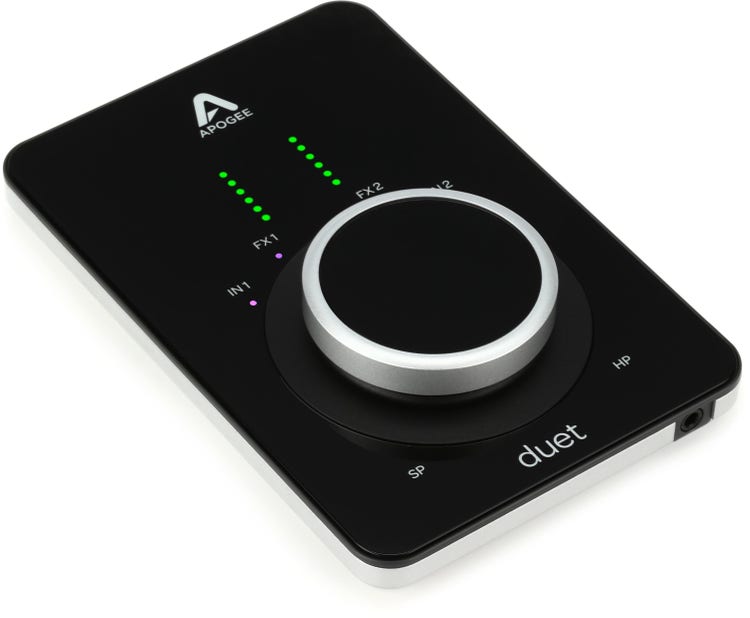
Gone is the iconic rotary dial and cabling of the Duet 2. The Duet 3 presents a stunning, contoured aluminum body topped with a scratch-resistant Gorilla Glass panel that houses a crisp OLED meter display. It’s a beautiful and incredibly sturdy object that feels every bit the premium product.
The much-debated breakout cable has been completely redesigned. It’s now longer, more robust, and features a streamlined connector that locks securely into the main unit. It provides two combo XLR/jacks for microphones/instruments and two balanced TRS outputs, consolidating the I/O neatly. For many, this design is a boon for cable management and portability; others who require frequent plug changes may find it less convenient than front-mounted jacks. On the front, you’ll find a single, powerful headphone output and a large, responsive multifunction encoder.
Being bus-powered via USB-C is a major win for mobility, allowing you to run the interface from a laptop without a power brick. Note that an external USB-C power supply is optional for those who need it.
Sound Quality: The Legend Continues
If you’re familiar with Apogee’s reputation, you know what to expect: impeccable sound. The Duet 3 does not disappoint. The AD/DA converters are simply top-tier, offering a clean, detailed, and dimensionally accurate sound that punches far above its weight class. Monitoring through this interface provides a clear, uncolored window into your mix, making critical decisions a breeze.
The microphone preamps are a highlight. Featuring Apogee’s Advanced Stepped Gain Architecture, they offer a clean, quiet, and whopping +65dB of gain. Even with gain-hungry ribbon mics or quiet sources, we found we could push the preamps hard without encountering the nasty hiss or distortion that plagues lesser interfaces. The sound is transparent, detailed, and perfectly captures the character of the source.
The Game Changer: Hardware DSP & ECS Channel Strip
This is the Duet 3’s killer feature. The onboard DSP allows you to run Apogee’s superb ECS Channel Strip with true zero-latency right at the input stage. This is a monumental advantage for recording.
The ECS Channel Strip, tuned by legendary mixer Bob Clearmountain, includes an excellent EQ, a musical compressor, and a lush saturation stage. Being able to commit to a light, Clearmountain-style compression or add a touch of air with the EQ on the way in is a creative luxury previously reserved for much larger, more expensive systems. It makes monitoring a pleasure and can dramatically improve the sound heading into your DAW, reducing the need for heavy processing later.
A crucial note: The included ECS Channel Strip runs only on the Duet 3’s hardware DSP. To use it as a plug-in inside your DAW on other tracks, you must purchase the native version separately. This is a slight disappointment but understandable given the processing power required and the value of the zero-latency tracking feature.
Control is handled seamlessly through the well-designed Apogee Control 2 software, which allows you to manage routing, create monitor mixes, and adjust the ECS settings. The accompanying Apogee Channel FX plug-in is genius—it lets you control the hardware’s preamp gain, phantom power, and even print the ECS effects from within your DAW session.
Pros & Cons
Pros:
- Reference-grade AD/DA conversion and pristine preamps.
- Onboard DSP enables zero-latency processing with the excellent ECS Channel Strip.
- Beautiful, robust, and portable bus-powered design.
- Improved, longer breakout cable.
- Excellent software integration with Control 2 and the Channel FX plug-in.
- Includes a high-quality travel case.
Cons:
- The breakout cable isn’t for everyone; some will prefer front-panel jacks.
- The hardware version of the ECS Channel Strip is tied to the interface; the native DAW version is a separate purchase.
- Priced at a premium compared to basic 2-in/2-out interfaces.
Conclusion
The Apogee Duet 3 is a masterclass in focused engineering. It takes the core strengths of its predecessors—flawless sound and portability—and elevates them with a genuinely innovative and useful DSP feature set.
It’s not for the budget-conscious beginner, but for the serious musician, podcaster, or mobile producer, it represents a fantastic value. The ability to track with world-class processing and zero latency is a workflow revolution that can save time and inspire creativity. When you factor in the impeccable sound quality and beautiful design, the Duet 3 isn’t just an audio interface; it’s a complete mobile recording solution that stands alone in its category.
Verdict: Highly Recommended. Apogee has once again set the benchmark for what a portable audio interface should be.