
















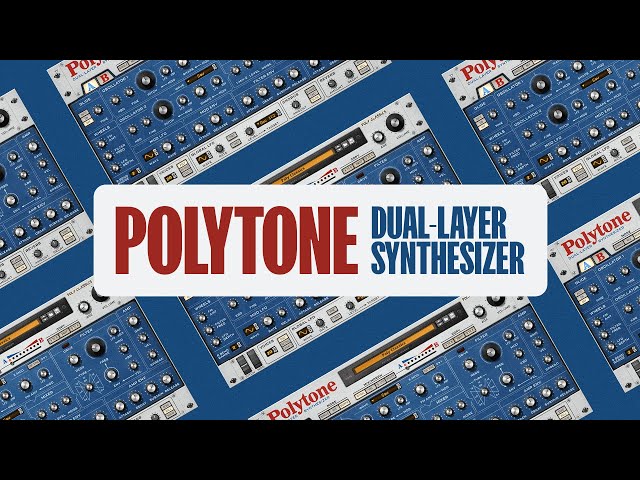
In this Polytone synth review, we take a closer look at how Polytone positions itself in a crowded market of virtual analog instruments. Polytone delivers both a tribute to classic subtractive synthesis and a forward-thinking evolution, enhancing vintage-style tones with modern flexibility while keeping the workflow fast and musical.
For more reviews like this, check out our product reviews section: https://dopetrackz.com/category/music-gear/
First Impressions
Polytone immediately appeals to producers who value speed. There’s no mod matrix maze or menu-diving fatigue here. The interface is clean, direct, and purpose-built—very much in line with the philosophy of vintage hardware, but without the limitations.
The synth is built around a dual-layer architecture, with Layers A and B acting as two fully independent synth engines. This is where the Polytone synth starts to separate itself from typical analog emulations.
Sound Engine & Architecture
At its core, the Polytone synth uses a two-oscillator subtractive design, but it’s far from basic. Each oscillator offers:
- Classic analog waveforms
- Additional shaping via a Shape control for timbral variation
- FM capabilities
- Oscillator sync
- Stereo spread for width
- Noise generation, including a standout Chaos noise mode
That Chaos noise deserves special mention—it introduces unpredictable, almost organic textures that go beyond traditional white or pink noise, adding character that feels less static and more alive.
Dual-Layer Power: Mix vs Morph
The real innovation of the Polytone synth lies in how the two layers interact.
You can:
- Mix Layers A and B for stacked, thick tones (effectively giving you a 4-oscillator sound)
- Morph between them for evolving, dynamic patches
Morphing isn’t just a gimmick—it’s deeply integrated into performance. You can control it via:
- Fader
- Global LFO
- Velocity
- Mod wheel
- CV input
This makes the Polytone synth particularly strong for cinematic textures, ambient production, and modern hip-hop sound design where movement is key.
Filter & Modulation
The filter section continues the theme of flexibility without complexity. Instead of fixed modes, the Polytone synth uses a continuously variable filter that sweeps smoothly between:
- Low-pass
- Band-pass
- High-pass
Add to that audio-rate Filter FM, and you’ve got access to aggressive, harmonically rich tones that go well beyond traditional subtractive synthesis.
The “Age” Control: Vintage Done Right
One of the most musical features in the Polytone synth is the Age control. Rather than simply adding noise or distortion, it introduces:
- Pitch drift
- Subtle instability
- Analog-style imperfections
The result is a convincing vintage feel without overdoing it. Dial it in lightly, and your patches gain warmth. Push it harder, and you enter lo-fi, warbly territory.
Workflow & Usability
The Polytone synth excels in usability. Everything is:
- Immediate
- Clearly laid out
- Designed for quick tweaking
There’s no friction between idea and execution. This makes it especially appealing for producers working on tight creative timelines—like building beats, scoring, or sound designing on the fly.
Sound Quality
Sonically, the Polytone synth hits the mark:
- Warm and full in the low end
- Smooth but detailed in the mids
- Capable of bright, cutting highs without harshness
Stacked layers can produce massive sounds, while morphing patches feel modern and expressive.
Pros
- Dual-layer engine adds real depth and flexibility
- Morphing system is performance-ready and highly musical
- Chaos noise introduces unique textures
- Age control delivers convincing analog character
- Clean, intuitive interface with no menu diving
Cons
- No deep modulation matrix (may limit power users)
- Focused design means fewer “experimental routing” options compared to modular-style synths
Verdict
The Polytone synth strikes a smart balance between vintage inspiration and modern innovation. It doesn’t try to be everything—instead, it focuses on delivering great analog-style sounds quickly, with just enough extra depth to keep things interesting.
For producers who want:
- Fat analog tones
- Evolving textures
- Fast workflow
…it’s an easy recommendation.
Polytone isn’t just another analog emulation—it’s a streamlined creative tool that understands how modern producers actually work.
For more details or to explore the synth further, visit the official page here:
https://www.reasonstudios.com/devices/polytone