











When it comes to creating basslines that feel alive instead of locked to a robotic grid, Ursa Bass Engine by Shane TV delivers one of the most innovative generative sequencing tools currently available for Reason Rack users. Designed to transform simple held chords into dynamic, evolving bass performances, Ursa bridges the gap between algorithmic composition and authentic groove.
For producers working in hip-hop, trap, drill, boom bap, house, synthwave, Latin music, and experimental electronic genres, Ursa offers an entirely new way to approach low-end composition. Instead of manually programming every note, users can generate repeatable, musical bass performances that remain tightly locked to key and scale while still feeling organic and human.
Whether you’re crafting underground hip-hop bangers, atmospheric drill records, or soulful boom bap productions, Ursa Bass Engine may become one of the most powerful workflow accelerators available inside the Reason ecosystem.
Looking for more music production gear reviews? Visit Dopetrackz Radio’s Product Reviews section:
https://dopetrackz.com/category/music-gear/
First Impressions
At first glance, Ursa Bass Engine appears to be another MIDI bass generator. Spend a few minutes with it, however, and it becomes clear that Shane TV has built something much deeper.
The device centers around a sophisticated 4-Cell Generative Engine that creates bass phrases rather than simple loops. Instead of endlessly repeating the same pattern, Ursa divides musical ideas into four separate sections that can each evolve independently.
The result is a bassline that develops over time while remaining deterministic and repeatable—an important distinction for producers who need consistency during arrangement and mixing.
This phrase-based approach immediately separates Ursa from many generative sequencers that rely too heavily on randomization.
20 Algorithmic Voices Cover Nearly Every Genre
One of Ursa’s biggest strengths is its collection of 20 unique bass-playing algorithms, known as Voices.
These aren’t simply preset grooves. Each Voice fundamentally changes how the engine performs, reacts to syncopation, applies ratchets, and interprets phrase endings.
Standout Voices include:
Concrete
Built specifically for modern trap and drill production. Massive 808-style rolls, octave drops, and aggressive ratchets make this one of the strongest presets for contemporary hip-hop producers.
Nod
Inspired by J Dilla-style swing, this Voice introduces subtle timing shifts, ghost-note velocity variations, and laid-back groove characteristics that feel remarkably human.
Montuno
A Latin-inspired algorithm delivering syncopated rhythmic movement that works exceptionally well for Afro-Latin fusion, reggaeton, and crossover productions.
Boom
Perfect for producers seeking heavyweight sub-bass movement with long note durations and room-shaking sustain.
Glitch
An experimental mode that abandons traditional looping altogether, triggering unpredictable bursts of randomized notes and ratchets on demand.
The diversity of these Voices gives Ursa a versatility rarely found in bass generation tools.
The 4-Cell Engine Is Where the Magic Happens
Most sequencers focus on creating patterns.
Ursa focuses on creating phrases.
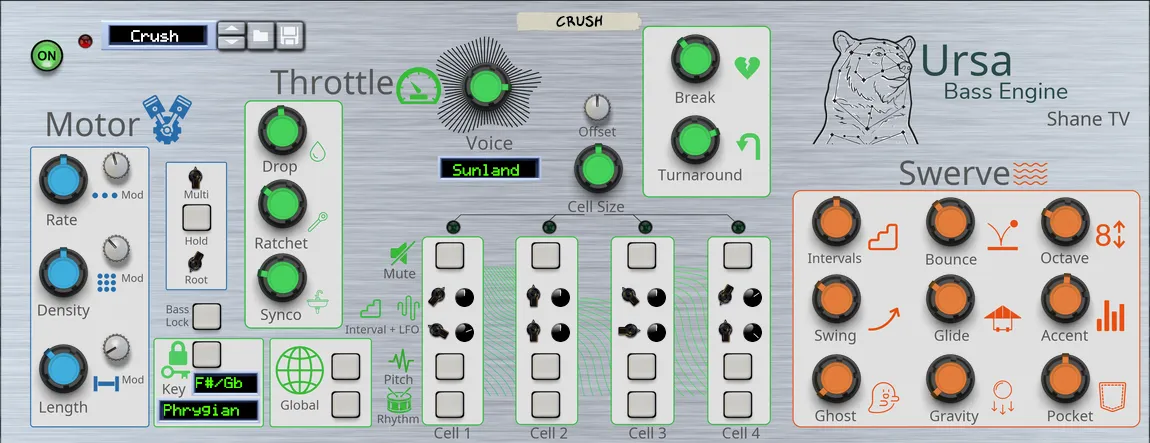
The 4-Cell System divides loops into four independent quadrants ranging from one-quarter bar up to four bars each. Every cell can contain its own pitch seed, rhythm seed, interval movement, modulation settings, and mute state.
This means a 16-bar bass phrase can continuously evolve while maintaining a coherent musical identity.
For hip-hop producers, this solves one of the biggest issues with loop-based bass programming: repetition fatigue.
Basslines feel composed rather than programmed.
Motor, Throttle & Swerve: Three Layers of Groove Control
Ursa’s interface is divided into three primary performance sections.
Motor Section
The rhythmic engine.
Rate, Density, Length, and Time Multiplier controls make it easy to shift between sparse, moody bass patterns and hyperactive rhythmic movement.
Built-in modulation options allow basslines to breathe naturally over time.
Throttle Section
The performance brain.
Syncopation, Ratcheting, Breaks, Turnarounds, Drops, and Voice selection combine to create highly expressive performances.
The Ratchet control deserves special praise. Rather than merely repeating notes, ratchets behave differently depending on the selected Voice, resulting in stylistically appropriate fills and rolls.
Swerve Section
The humanizer.
Swing, Glide, Bounce, Pocket, Accent, Ghost Notes, and Velocity Pocketing add the imperfections that transform mechanical bass patterns into believable performances.
The Pocket control is particularly impressive, allowing producers to subtly push or pull MIDI timing for additional groove.
Built For Modern Hip-Hop Production
While Ursa can handle nearly any style of electronic music, its strongest applications may be found in hip-hop.
The Concrete, Nod, Hustle, Pocket, and Trench Voices feel purpose-built for modern rap production.
808 rolls emerge naturally.
Ghost notes add realism.
Velocity changes create movement.
Swing introduces bounce.
Ratchets generate trap-inspired fills without tedious manual editing.
For producers creating multiple beats per day, Ursa can dramatically accelerate workflow while maintaining professional-level results.
Advanced CV Integration Sets It Apart
Reason users who enjoy modular routing will appreciate Ursa’s fully routable back panel.
Nearly every parameter features dedicated CV inputs, each equipped with its own trim attenuator.
This seemingly small feature becomes incredibly useful in larger modular setups where modulation amounts require precise control.
Being able to scale incoming CV signals directly from the device eliminates much of the workaround routing typically needed inside complex Reason projects.
Ursa also includes dedicated Gate Out and Pitch Out connections, allowing users to drive external modular systems, Rack Extensions, and legacy instruments.
For advanced users, this flexibility significantly expands the device’s creative potential.
Sound Quality & Musicality
Technically speaking, Ursa doesn’t generate audio—it generates MIDI performances.
The quality therefore comes from the musical decisions made by the engine itself.
Fortunately, the algorithms are remarkably musical.
Even heavily randomized phrases tend to remain coherent, groove-oriented, and useful within a production context.
The integrated quantizer further ensures basslines stay locked to scale while still providing enough variation to feel spontaneous.
The “Chord Aware” Auto mode is especially useful during idea generation and experimentation.
Areas for Improvement
Ursa is powerful, but it isn’t completely beginner-focused.
The sheer number of controls may initially overwhelm users unfamiliar with generative sequencing concepts.
Some producers may also wish for visual phrase editing or MIDI drag-and-drop functionality for exporting patterns directly to a DAW timeline.
However, these are relatively minor complaints considering the depth of functionality provided.
Final Verdict
Ursa Bass Engine successfully solves one of electronic music production’s oldest problems: making programmed basslines feel human.
Its combination of phrase-based generation, 20 distinct playing styles, advanced groove controls, intelligent quantization, and extensive CV routing creates a device that feels equally useful for quick inspiration and deep sound-design workflows.
For Reason producers working in hip-hop, trap, drill, boom bap, house, synthwave, or experimental electronic music, Ursa delivers a level of bassline intelligence rarely found in MIDI generation tools.
The standout feature isn’t the randomization—it’s the musicality.
Ursa consistently produces bass performances that sound intentional, expressive, and surprisingly human.
Rating: 9.2/10
Pros
- Exceptional phrase-based bass generation
- 20 highly distinctive algorithmic Voices
- Excellent trap and hip-hop performance modes
- Deep humanization controls
- Full CV implementation with trim attenuators
- Deterministic and repeatable sequences
- Strong modular integration
Cons
- Learning curve for beginners
- No direct MIDI drag-and-drop export
- Depth may overwhelm casual users
Learn more about the Ursa Bass Engine:
https://www.reasonstudios.com/shop/rack-extension/ursa-bassline-generator
W.D.O.P.E. Dopetrackz Radio Recommendation: Highly Recommended for Reason producers seeking intelligent, humanized bass generation and faster low-end workflow creation.